3 to read: Takedown of a Cabinet secretary | Why can’t FB beat back the trolls? | Make Twitter useful (again)

By Matt Carroll <@MattCData>

Oct. 7, 2017: Cool stuff about journalism, once a week. Get notified via email? Subscribe: 3toread (at) gmail. Originally published on 3toread.co

  1. Takedown: The inside story on how HHS Secy Price got caught: Wonderful first-person account from the Politico reporters who blew open the story, forcing Thomas Price to resign for using high-cost charter flights when commercial planes were available. It involves stakeouts at airports, hot anonymous tips, and dogged reporting. Well done, Dan Diamond and Rachana Pradhan.

2. Facebook & Google keep getting gamed by trolls — just look at Las Vegas: Everybody’s favorite duopoly talks big about blocking the trolls throwing up fake news. But the trolls don’t seem to have much trouble figuring out how to game their algorithms. Look at Las Vegas: Stories got big play about the how the shooter was an anti-Trump liberal, linked to the Islamic state. Or not. The situation shows the problems facing Facebook and Google, and how far they are from solutions. Good stuff by Kevin Roose at the NYT.

3. How to use Tweetdeck & advanced search to make Twitter useful (again): Feeling like the flood of tweets is making Twitter too much of a pain? Never fear, here are some simple (but effective) tips that make Twitter so much more useful as a newsroom tool again. Nice work by Ren Laforme for Poynter.

  • Get notified via email: Send a note to 3toread (at) gmail.com

Matt Carroll teaches journalism at Northeastern University.

3 to read: The revolution will be immersive | Engagement: Learning from churches & book clubs | Society news was the old Facebook

By Matt Carroll <@MattCData>

Sept. 30, 2017: Cool stuff about journalism, once a week. Get notified via email? Subscribe: 3toread (at) gmail. Originally published on 3toread.co

  1. The revolution will be immersive: An interesting piece about where journalism is headed. A couple of thought leaders at the AP, Francesco Marconi, a strategy manager, and Taylor Nakagawa, an emerging media fellow, say the future of journalism is 3D and AR, writes Sophia Fox-Sowell for Storybench. They’ve published a guide for newsrooms: “The age of dynamic storytelling: a guide for journalists to immersive 3-D content.” It’s a tectonic shift for consumers. Instead of passively looking at photos or reading text, consumers are now challenged to “explore and create their own narratives.” Interesting stuff.

2. What newsrooms can learn about engagement from churches & book clubs: In an era of disruption, newsrooms are struggling to understand the new rules of engagement and how to build community. Ruth Tupe for The Membership Puzzle Project argues that news needs to look and learn from different organizations that vary as widely as coworking space and art museums. After all, many types of organizations have been asking themselves the same questions for years, while newsrooms are only getting started. Cool tips and anecdotes about what has worked.

3. Before Facebook was Facebook, society columns provided news — and community: Newspapers tended to shrug off the society columns as filler for somewhere in the back pages. But Sam Ford for CJR writes a wonderful ode to what is a disappearing piece of newspaper’s past. But those columns, write Ford, were important in ways maybe the page one editors never understood — they provided place and community for so many readers. (Sam should know. He took over his grandmother’s column at the ripe old age of 12.)

  • Get notified via email: Send a note to 3toread (at) gmail.com

Matt Carroll teaches journalism at Northeastern University.

3 to read: Future of news is all about voice | State of data reporting | How Vox uses Facebook groups

By Matt Carroll <@MattCData>

Sept. 24, 2017: Cool stuff about journalism, once a week. Get notified via email? Subscribe: 3toread (at) gmail. Originally published on 3toread.co

  1. The future of news is humans talking to machines: “Pivot to video”? Screw that. The future of newsrooms all about getting news from Alexa, Siri, and Google. Or that’s the fascinating argument made by Nieman Fellow Trushar Barot for Poynter, who thinks voice interaction could have a bigger impact than the iPhone. That’s the interesting news. The bad news is that newsrooms are about to miss out, just like they missed the Internet, if they don’t catch up quick. Provocative stuff.

2. The state of data reporting: Improving quickly: As a long-time data geek myself (and now teaching data reporting), this report is heartening. Half of all newsrooms — and 60% of digital only — have a dedicated data nerd. The report by Google News Lab, which surveyed more than 900 reporters and editors, has some interesting nuggets. For instance data is often used in quick-hit stories — about half of the respondents took a day or less to do a data story, while about 10% took several weeks.

3. What Vox learned building groups & communities on Facebook: Interesting insights from Vox about how a newsroom can use Facebook to create engaged groups. For instance, Vox created special interest groups, such as one around Obamacare, which made it easier for them to find sources for stories. And surprisingly (well, to me anyways), members of groups were good about moderating other members. The tone of discussion also deepened over time as members got to know one another. Good stuff for newsrooms wishing to dive deeper in Facebook Groups.

  • Get notified via email: Send a note to 3toread (at) gmail.com

Matt Carroll teaches journalism at Northeastern University.

3 to read: David Carr: A memorable teacher | Political tide rising against Facebook? | Anatomy of murder

By Matt Carroll <@MattCData>

Sept. 18, 2017: Cool stuff about journalism, once a week. Get notified via email? Subscribe: 3toread (at) gmail. Originally published on 3toread.co

  1. David Carr: An appreciation of a super mentor: The late David Carr of the NYT led an incredible life — media critic, editor of the alt-weekly Washington City Paper, and a crack addict who wrote a searing memoir about his own addiction and recovery. He was also a wonderful, memorable mentor to a generation of talented writers. Here’s the words from a dozen of those he helped, cajoled, pushed — and made better journalists. A wonderful read by Mikaela Lefrak for The Atlantic.

2. Is the political tide turning against Facebook & Google?: Facebook is the social platform journalists love to hate. It’s huge, non-transparent, refuses to acknowledge its out-sized role as a media company — and pockets all that advertising cash that used to pay reporter salaries. It’s also essential for driving mega traffic (hence revenue) to news sites. It turns out that a growing number of people don’t much love FB (or Google or Amazon) either. Ben Smith of BuzzFeed takes a thoughtful look at how a loose coalition of powerful figures is slowly raising the anti-trust flag, and asking whether some of these companies should be broken up.

3. Anatomy of murder: How The Economist does data journalism: A fascinating data viz of murder in the US — and great insight into how the Economist does this kind of work. Well worth a (long) look. Addictive. An interview with The Economist’s David Fransham on Medium.

  • Get notified via email: Send a note to 3toread (at) gmail.com

Matt Carroll teaches journalism at Northeastern University.
=====================ADVERTISEMENT==========================

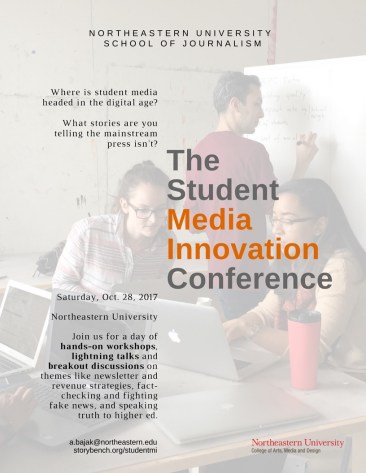
The Student Media Innovation Conference.jpg