3 to read: WaPo goes transparent | NYT’s own sex scandal | How Breitbart declared war on Twitter

By Matt Carroll <@MattCData>

Dec. 16, 2017: Cool stuff about journalism, once a week. Get notified via email? Subscribe: 3toread (at) gmail. Originally published on 3toread.co

  1. How the WaPo broke the Roy Moore story & got more transparent: First, this is interesting piece for journalists curious about how the WaPo got the story. But secondly — and maybe more importantly — it’s eye opening for people outside the business, who might wonder how “sausage is made.” It’s the Post’s first story in what will be a series in “deconstructing the journalistic process.” It’s also a great example of how newsrooms can be more transparent and can increase trust when the public has become increasingly skeptical and cynical about the media.

2. Scandal at the NYT: Investigation into allegations against star reporter Glenn Thrush: There’s no shortage of irony here. The New York Times, after all, kicked off the blistering #metoo movement with its incredible reporting on Weinstein. Now, one of its star White House reporters has been suspended after a report in Vox about how Thrush allegedly made moves on younger female reporters. This Vanity Fair piece by Joe Pompeo describes a strong response from the NYT: Dozens interviewed in rigorous interviews. Stay tuned.

3. How Bannon, Milo & Breitbart declared war on Twitter: BuzzFeed has written a fascinating inside look at how Breitbart’s Steve Bannon roared into battle against Twitter, convinced that the tweet machine was blocking conservative voices and banning his employees, including then-star Milo Yiannopoulos. “Should we sue Twitter?” Yiannopoulos wrote in an email to Bannon. “Already talked to lawyers,” replied Bannon. A tale about how Bannon unleashed Breitbart against Twitter, trying their best to hurt the social network. Great work by Joseph Bernstein and Ryan Mac.

BTW: Taking holiday time. Next post on Jan. 13.

  • Get notified via email: Send a note to 3toread (at) gmail.com

Matt Carroll teaches journalism at Northeastern University. Twitter: @MattcData. Instagram: mattcarroll54.


3 to read: 13 tips from ‘Spotlight’ reporter | Live-streaming transforms journalism | Bribing freelancers

By Matt Carroll <@MattCData>

Dec. 9, 2017: Cool stuff about journalism, once a week. Get notified via email? Subscribe: 3toread (at) gmail. Originally published on 3toread.co

  1. Mike Rezendes of the ‘Spotlight’ movie has 13 tips for investigative reporters: Looking for some tips on how to be a good investigative reporter? Mike Rezendes of the Boston Globe (and Spotlight movie fame) has some excellent tips, from the simple to the profound. Mike, who is a friend and former colleague, has been doing this for a long time and knows what he is talking about. Check them out.

2. The live-streamers who are challenging traditional journalism: Never mind the “coming” revolution with AR and VR. There’s already a revolution going on, and it’s with live-streamers. A fascinating trip with Tim Pool, one of the top live-streamers out there, and how he goes about his business. His stuff is raw, confusing, occasionally boring as all hell — but often riveting. It’s clear this is one direction journalism is headed. Nice story by Andrew Marantz in the New Yorker.

3. How brands secretly buy their way into Forbes, Fast Co & HuffPo stories: Take a peek behind the curtain at the (very) dark side of freelance journalism. It’s about how brands secretly buy their way into digital news stories on sites ranging from Forbes to Fast Company by — shocker — bribing the news site’s freelance writers. It’s not exactly surprising given the pittance paid by newsrooms to those freelancers scratching out a miserable economic living in the “gig economy.” But it is certainly ugly and embarrassing for everyone involved. Nice work by Jon Christian for TheOutline.

  • Get notified via email: Send a note to 3toread (at) gmail.com

Matt Carroll teaches journalism at Northeastern University

Logo by Leigh Carroll <Instagram @Leighzaaah>


3 to read: NPR? What the heck? | Breaking down Russia’s FB ads | Civil war at WSJ?

By Matt Carroll <@MattCData>

Nov. 4, 2017: Cool stuff about journalism, once a week. Get notified via email? Subscribe: 3toread (at) gmail. Originally published on 3toread.co

  1. Behind the scenes: What the heck happened at NPR?: Michael Oreskes, the senior VP and editorial director of NPR, was ousted for sexual harassment at the liberal bastion, caught up in the Weinstein whirlwind. But while some details have been released, much remain murky: What happened behind the scenes? Who knew what when? Megan Garber of The Atlantic does a nice job creating a tick-tock of events — including what top NPR officials knew several years ago.

2. How Russian Facebook ads worked so effectively: An excellent data viz showing how the Russians used Facebook ads so well — and how the bad actor ads were spotted. In a nutshell, they created divisiveness by manipulating strong emotions and wrapping their subjects in the American flag. Great work by Leslie Shapiro at the WaPo.

3. Is civil war breaking out in WSJ over the editorial board’s coverage of Mueller?: Oh boy, it’s getting ugly at the Journal. Joe Pompeo at Vanity Fair writes an intriguing story about how the WSJ’s whacky editorials over Mueller are helping drive an exodus of top talent. Or as one former high-ranking Journal writer tweeted: “WSJ edit page has gone full bats — t.”

=== +++ ===

Cool event:

  • Get notified via email: Send a note to 3toread (at) gmail.com

Matt Carroll teaches journalism at Northeastern University.

3 to read: Reporting a timeline, pixel by pixel | Cool dataviz: ‘You draw it’ | Millennials *will* pay for news

By Matt Carroll <@MattCData>

Oct. 28, 2017: Cool stuff about journalism, once a week. Get notified via email? Subscribe: 3toread (at) gmail. Originally published on 3toread.co

  1. The Las Vegas shooting: How to report a timeline, pixel by pixel: In a series of tweets, Malachy Browne, a producer in the NYT’s video unit, basically conducts a master class on how to build a complicated timeline by combining a number of video clips. It’s a fascinating tweet stream. (Click on the tweet linked in the story to see all the tweets.) It’s a great learning experience, even for experienced reporters.

Logo by Leigh Carroll (Instagram: @Leighzaah

2. Simply, a cool NYT dataviz: ‘You draw it’: Another great example from the NYT, which continues to do top-notch data viz. “You draw it: Just how bad is the drug overdose epidemic?” informs, while providing (grim) information about how Americans have died over the past few decades in everything from car crashes to opioids. (Check out the crazy AIDS timeline.) Kudos to their graphics team and Josh Katz, who did this one.

3. Maybe the apocalypse isn’t *that* close: Millennials are paying for news: The commonly accepted wisdom is that millennials won’t crack open their wallets for news. Maybe that needs a digital update. Millennials — in increasing numbers — are paying, according to an impressive collection of publications: The Atlantic, NYT, WaPo, WSJ, and the Economist, among others. Driving the surge? Millennials are getting used to paying for digital content through sites such as Netflix, while the “Trump bump” gets some credit too.

+ ===== +

Cool upcoming event:

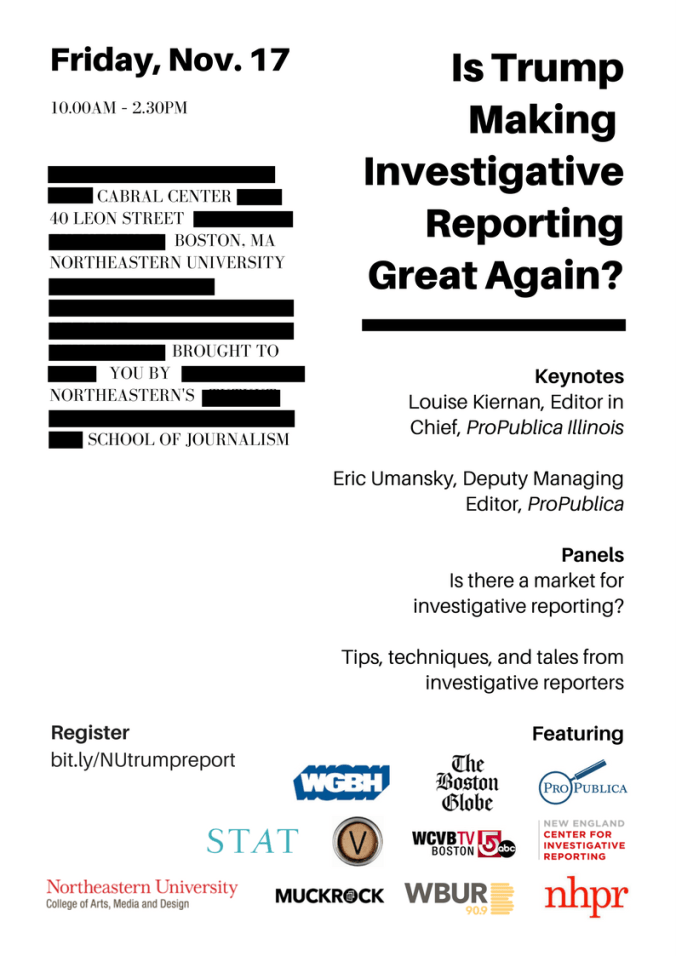
The-Future-of-Investigative-Reporting_11-31-17

Is Trump Making Investigative Reporting Great Again?

When: Fri. Nov. 17

Where: Cabral Center, O’Bryant African-American Institute

40 Leon St., Northeastern University, Boston

Cost: Free

Register: bit.ly/NUtrumpreport

Keynote speakers: Louise Kiernan, editor in chief, ProPublica Illinois & Eric Umansky, deputy managing editor, Pro Publica

Panels:

  • Is there a market for investigative reporting? (Tom Melville, WBUR; Anne Galloway, VTDigger; Burt Glass, NECIR; David Hurlburt, WCVB)  
  • Tips techniques and tales from investigative reporters (Mike Rezendes, Boston Globe; David Armstrong, StatNews; Casey McDermott, NH Public Radio; Mike Morisy, MuckRock)


  • Get notified via email: Send a note to 3toread (at) gmail.com

Matt Carroll teaches journalism at Northeastern University.